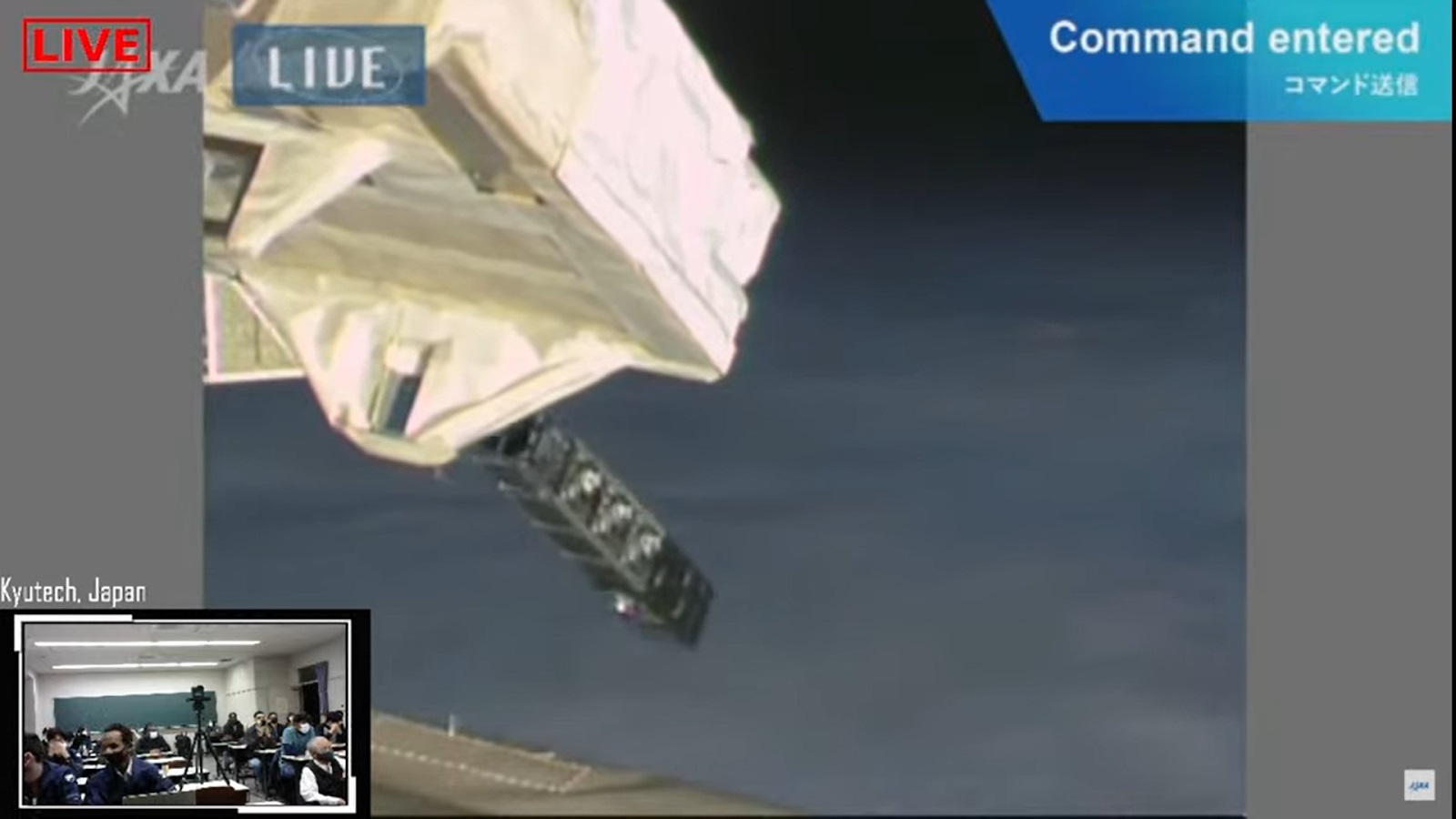
Another milestone for the Philippines in the area of space technology happened on 14 March 2021 at around 7:20 PM when Maya-2, another cube satellite (CubeSat) made by Filipino engineers studying in Japan, was released from the International Space Station (ISS).
Incidentally, Maya-2 was launched to the ISS from earth aboard the Cygnus NG-15 rocket (S.S. Katherine Johnson) on 21 February 2021, together with CubeSats Tsuru (Japan) and GuaraniSat-1 (Paraguay). The release of Maya-2, the fourth successful attempt to send a satellite to space in collaboration with Japan, seals the commitment of the Philippines to continue to nurture the longstanding partnership with the said country.
Maya-2, together with CubeSats Tsuru of Japan, and GuaraniSat-1 of Paraguay, was designed and developed under the 4th Joint Global Multi-Nation Birds Satellite (BIRDS-4) Project of the Kyushu Institute of Technology (Kyutech) in Japan. Their primary purpose is to create a technology demonstration from which the learnings will be used as an educational platform.
Maya-2 can remotely collect data using a Store-and-Forward (S&F) mechanism and capture images and videos using an on-board camera. Its 1.3 kg frame is also equipped with an Automatic Packet Reporting System Message Digipeater (APRS-DP), attitude determination and control units for active attitude stabilization and control demonstrations, Perovskite solar cells, and a Latchup-detection chip.
In his statement, Department of Science and Technology (DOST) Secretary Fortunato T. de la Peña shared his gratitude and excitement on the successful launching of Maya-2. He said that the accomplishment of our young Filipino researchers and engineers should make us more confident that we can do more in the area of space technology.
“I have high hopes that we as a people will be able to benefit more from developments in this area—all towards making the quality of life of our people better,” said DOST Secretary de la Peña.
According to de la Peña, this project will further intensify the efforts of the country to harness the power of satellite technology that can provide long-term benefits for the country that far outweigh the cost. The benefits will impact on the different sectors: in agriculture, forest cover and natural resources inventory, weather forecasting, and disaster damage assessment and monitoring, among others.
The science chief added that the images captured by these cube satellites and information generated, in particular, can be a strong basis for policy recommendations, project implementation, and decision-making that will benefit various sectors of society.
The three Filipino engineers were sent to Kyutech by the Department of Science and Technology’s Science Education Institute (DOST-SEI) to pursue their doctoral degrees as part of a scholarship program done in cooperation with the Space Science and Technology Proliferation through University Partnerships (STeP-UP) Project or the STAMINA4Space Program. They are Izrael Zenar Casople Bautista (Project Manager), a graduate of BS Electronics and Communications Engineering from the University of the Philippines Diliman; Mark Angelo Cabrera Purio (Camera Mission Back Plane Board Design and Planning), a graduate of BS Electronics and Communications Engineering from Batangas State University; and Marloun Pelayon Sejera (Communication System Automatic Packet Reporting System-Digipeater Mission), a graduate of BS Electronics and Communications Engineering from the Mapua Institute of Technology.

BIRDS Project Principal Investigator Dr. Mengu Cho also shared that the primary goal of the project is to foster human resources to initiate indigenous space programs in non-space-faring countries.
“After seeing the infant space programs in many countries, I can say that the Philippines is one of the best examples of a success story for Maya-2, three students from the Philippines are engaged and play key roles in the entire BIRDS-4 project. I am sure that they can be an important asset to the future Philippine space program,” said Dr. Cho.
Meanwhile, Kyutech Assistant Professor George Maeda said that of all the BIRDS partners, none is more serious about developing in-country ‘human resources’ than the Philippines.
“Before you can make a spacecraft, you have to train engineers who know how to make them. The point is understood in your country. The fruit of knowledge acquired at Kyutech is taken to the Philippines and then applied to help others—this ‘multiplication of knowledge’ is precisely what we want to occur. This is what education is all about. It means to spread knowledge. Replace darkness with the light on a broad scale,” said Prof. Maeda.
On the other hand, DOST-SEI Director Josette T. Biyo stressed that Maya-2’s successful deployment in space is a living proof that the investment made in these scholarships is well worth it. She said that they exemplify the perseverance of Filipinos and the brilliance of our science scholars. Maya-2 proves that the country’s space program and science scholarships are investments worthy of people’s support.
After the scholars complete their studies, they have their eyes set on furthering the proliferation of the knowledge they gained in Japan and bring it back to the Philippines.
Engr. Purio said that aside from imparting what he learned in Japan to his alma maters, he envisions setting up our own ground station in the university to continue our efforts to support space-related activities while involving our students by providing them hands-on training.
As for Engr. Bautista, he hopes to contribute to the growing space industry back home. He plans to continue what he has learned in Japan, from his research in Perovskite solar cells to satellite systems engineering, to hopefully providing meaningful output for the Philippines.
—
Stay updated with news and information from the Department of Science and Technology by visiting their website at http://dost.gov.ph.