
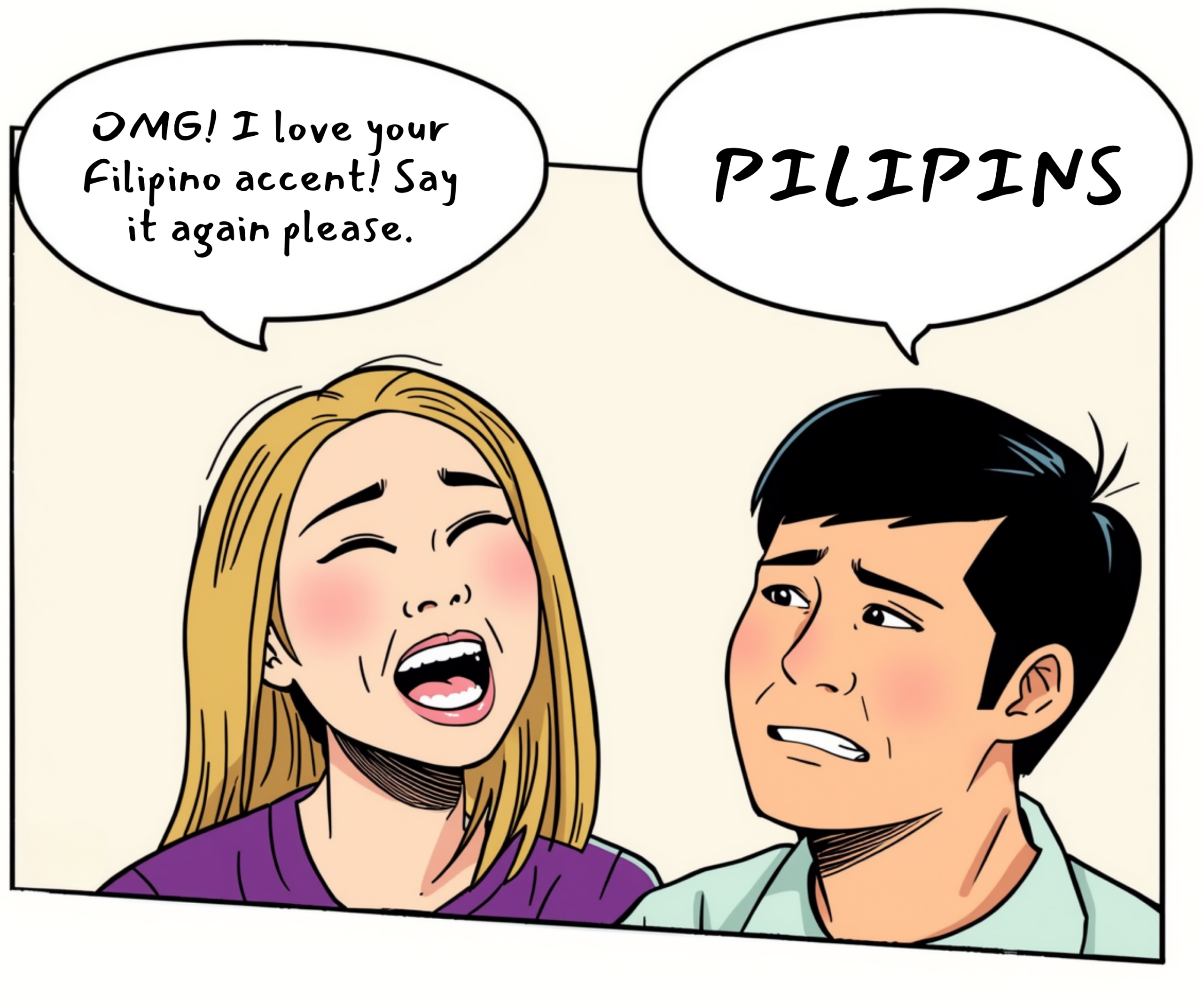
There was a time when Filipinos would contort their tongues into shapes they had no business making. They would flatten their vowels, drawl their syllables, and swallow the ends of words in a desperate performance of borrowed identity. American. British. Neutral. Anything but Filipino. In school hallways, in call center cubicles, in the lobbies of multinational companies, the unspoken rule was clear: sound like someone else. Someone more credible. Someone from somewhere that was not here.
That time, thankfully, is loosening its grip.
THE RANKING THAT BROKE THE INTERNET
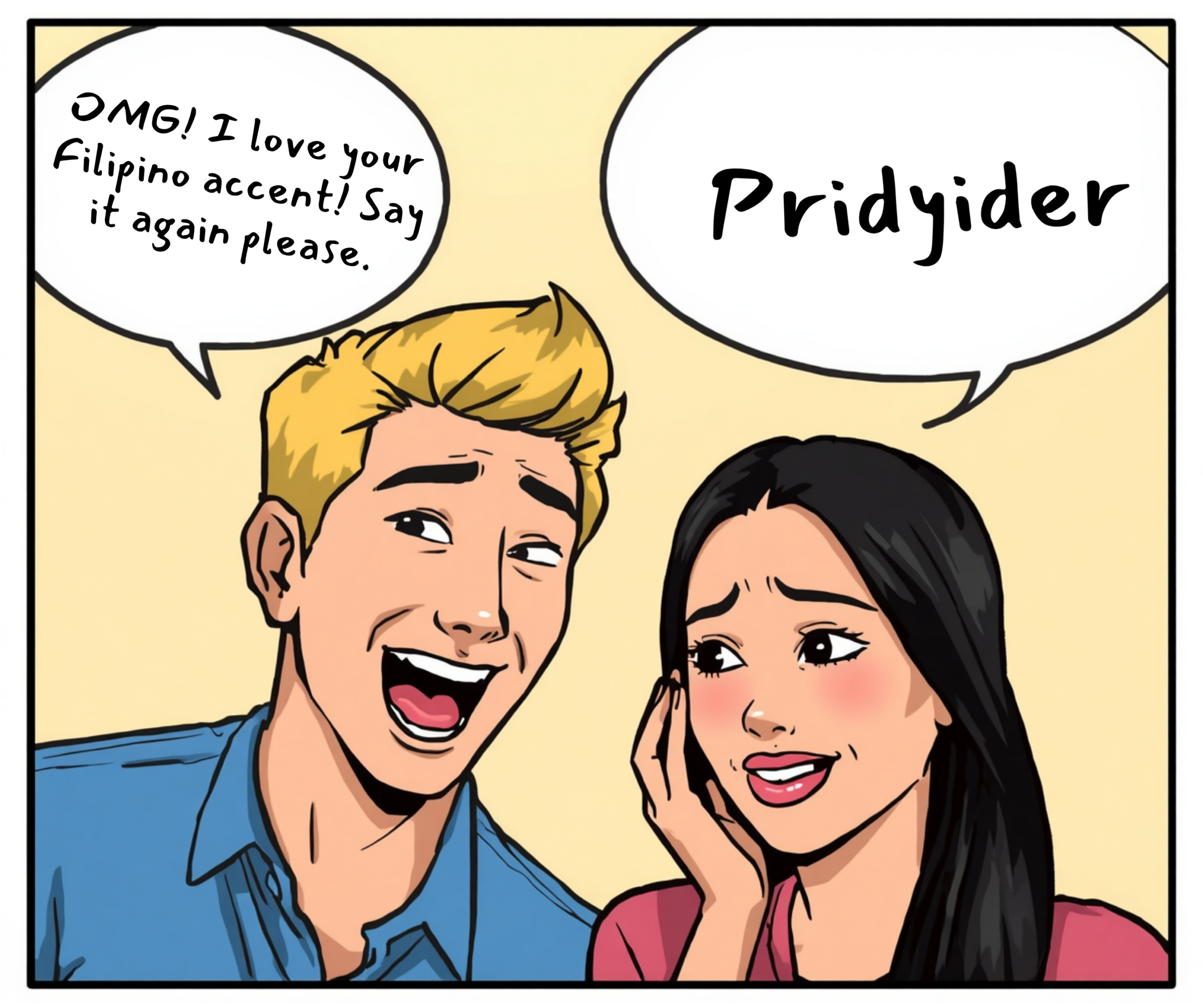
When travel platform EnjoyTravel.com ranked the Filipino accent as the sexiest in Asia and among the most attractive in the world, social media did what it does best: erupted. “Finally, our accent is being appreciated,” read one comment that gathered thousands of likes. “Now I won’t be shy speaking English in public,” wrote another. The reactions were not just celebratory. They were relieved. There was something almost tender about watching an entire nation collectively exhale.
The ranking cited the Filipino accent’s soft tone, fluid rhythm, and friendly cadence as key factors. To outsiders who encounter it for the first time, it registers as melodic, warm, and unusually clear. It does not carry the hard edges of some European accents or the tonal complexity of East Asian ones. It sits somewhere inviting, like a voice that already knows you.
A LANGUAGE SHAPED BY CENTURIES OF CONTACT
To understand where the Filipino accent comes from, you have to go back much further than a travel website’s rankings. Tagalog, the language at the core of Filipino, is built on one of the simplest phonetic systems in the world. It works with five vowel sounds and sixteen consonants, favoring open syllables that end cleanly and rhythmically. The word laro flows CV-CV, easy and open. The language does not naturally accommodate the clustering of consonants the way English does, which is why a Filipino speaker will often give each syllable its full due rather than let unstressed ones collapse into the schwa sound that American English depends on so heavily.
Then came the colonizers, and with them, entire phonetic worlds grafted onto that clean foundation. Spanish rule left behind not just vocabulary but sound: the rolled r in pera and pero, the softened consonants of mesa and familia. When America arrived, it brought aspirated consonants and an educational system conducted entirely in English, introducing stress patterns that did not exist in native Tagalog. The result was a hybrid speaker: someone who learned English formally, applied it through a Tagalog phonetic lens, and produced something that was neither purely American nor purely Filipino. Something entirely its own.
A COUNTRY OF VOICES, NOT JUST ONE ACCENT
The Philippines is not one accent. It is more than 170 languages spread across more than 7,000 islands, and every region carries its sound into the national language like a signature. Batangas Tagalog is forceful and marked by a sharp glottal stop, unmistakable to anyone who has heard ala eh said with full conviction. Ilonggo speakers bring a drawn-out lilt to their words, a melodic pull that softens even declarative sentences. Ilocanos carry a pronounced vowel into words where Manila Tagalog would round them off differently. Cebuano speakers sometimes bring their native tendency to shift certain consonants into their Tagalog. And Kapampangan speakers have been known to drop an initial h entirely, so that halika becomes something closer to ‘alika, softer and somehow more intimate.
The Manila accent, the one broadcast on national television and taught as standard in schools, is itself a blend of all these influences plus the additional layering of English code-switching so pervasive it has its own name: Taglish. But even that “standard” is a construction, a center of gravity that the provinces have never fully orbited.
THE YEARS WE SPENT PERFORMING SOMEONE ELSE’S VOICE
The colonial legacy of language in the Philippines runs deep and, in many cases, still runs raw. For decades, accent-shaming was not a fringe experience but a systemic one. Children were corrected in classrooms. Employees were sent to accent neutralization training before they were allowed to take calls from American clients. The message embedded in all of it was consistent and corrosive: the way you naturally speak is a liability.
The BPO industry, which employs millions of Filipinos, was for years the most visible arena of this erasure. Workers were trained to flatten their natural cadence, to adopt American idioms, to perform a version of themselves that would not register as foreign on the other end of the line. Some were exceptionally good at it. Others found the performance exhausting in ways that went beyond the vocal.
WHAT CHANGED, AND WHY IT MATTERS
The shift did not happen overnight and it did not happen because of one ranking. It happened because Filipino voices started appearing in spaces that could not ignore them. Bretman Rock built a global beauty empire speaking exactly the way he speaks. Bella Poarch became one of the most-followed people on TikTok without softening a single vowel. Filipino nurses, doctors, caregivers, and teachers filled critical roles across North America, the Middle East, and Europe and were recognized not despite how they sounded but alongside it. Over ten million Filipinos living abroad carried their accent into hospitals, classrooms, cruise ships, and embassies, and the world did not recoil. It listened.
The global market, slowly and then all at once, began to prefer authenticity over mimicry. Clients who once demanded neutralized accents started expressing preference for clear, relatable speech over a performance nobody fully believed anyway. What had been treated as a flaw turned out to be a feature.
SAY IT AGAIN, AND MEAN IT
The sexiest accent in Asia is not an accident of geography. It is the product of centuries of linguistic layering, of a people who absorbed Spanish cadence and American rhythm and regional melody and made something that belongs entirely to them. It is soft because Filipino culture values softness. It is warm because the people who speak it are. It is clear because clarity is something Filipinos have always worked hard for, in every sense of the word.
The generation now growing up does not carry the same weight of accent shame that their parents and grandparents did. They post videos in their natural voices. They represent the country in international competitions without apologizing for how they sound. They are the ones who will decide what the Filipino accent means going forward, and everything suggests they will decide it means something worth keeping.
So, the next time someone asks you to neutralize your accent, you have a ranking to cite. More importantly, you have a history that tells you there was nothing to neutralize in the first place.