Balikbayan Magazine
  • Balikbayan Magazine Quarterly
  • World
    • Asia
    • Australia
    • Canada
    • Russia
    • Latin America
    • United States
    • Europe
  • Business & Wealth
    • Entrepreneur
    • Real Estate
    • The Economy
    • Leaders
    • Technology
    • Retirement
  • Travel
    • Balikbayan Journals
    • Destinations
    • Hotels & Resorts
    • Travel Guide
    • Wine & Dine
  • Features
    • Arts & Culture
    • Columnists
    • Events
    • Publisher’s Note
    • Style
Balikbayan Magazine Balikbayan Magazine

The Global Business, Investment, & Travel Briefing for the Global Filipino Community

Balikbayan Magazine Balikbayan Magazine Balikbayan Magazine
  • Balikbayan Magazine Quarterly
  • World
    • Asia
    • Australia
    • Canada
    • Russia
    • Latin America
    • United States
    • Europe
  • Business & Wealth
    • Entrepreneur
    • Real Estate
    • The Economy
    • Leaders
    • Technology
    • Retirement
  • Travel
    • Balikbayan Journals
    • Destinations
    • Hotels & Resorts
    • Travel Guide
    • Wine & Dine
  • Features
    • Arts & Culture
    • Columnists
    • Events
    • Publisher’s Note
    • Style
Facebook
Instagram
  • Balikbayan Journals

A Closer Look at Bohol’s Tarsiers

  • September 26, 2024
  • Billy De La Cruz
Total
0
Shares
0
0
0
Share
Tweet
Share

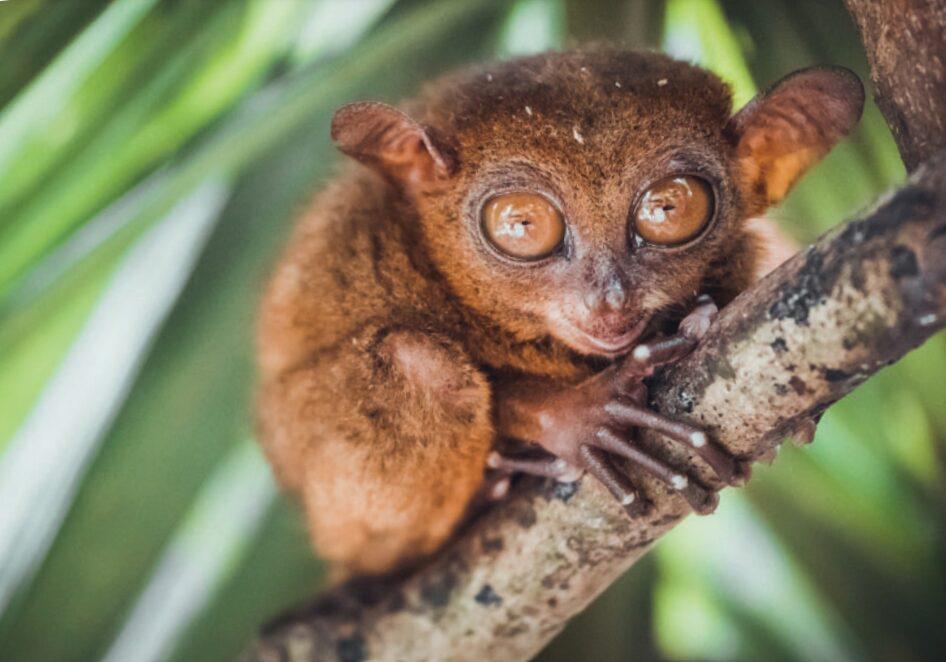
The Philippine tarsier, a tiny primate native to Bohol, continues to draw both scientific interest and tourist attention in 2024. These nocturnal creatures, famous for their enormous eyes, have become a major attraction for visitors to Bohol, rivaling even the iconic Chocolate Hills.

Tarsiers possess truly remarkable eyes. Each eyeball is fixed in its socket and measures about 16 mm in diameter – proportionally the largest of any mammal relative to body size. Fascinatingly, a tarsier’s eye actually outweighs its entire brain.

To compensate for their fixed eyes, tarsiers can rotate their heads nearly 180 degrees, allowing them to scan their environment effectively. Recent studies conducted by the University of the Philippines have revealed that tarsiers communicate using ultrasonic vocalizations, a discovery that provides new insights into their social behavior. This finding is significant for understanding their mating habits and group dynamics, which were previously difficult to observe in the wild.

Recent studies by the University of the Philippines have unveiled that tarsiers communicate using ultrasonic vocalizations, shedding new light on their social behavior. This discovery is by Billy De La Cruz IN THE NEWS crucial for understanding their mating habits and group dynamics, aspects of tarsier life that were previously shrouded in mystery. In response to growing tourist interest, the Bohol Tarsier Conservation Area has expanded its protected zones by 15% in 2024, now encompassing approximately 167 hectares of forest habitat. New regulations limit tourist groups to a maximum of 6 people per guide, with strict rules against flash photography and a mandatory 2-meter distance from the tarsiers.

Tarsiers are the world’s only fully carnivorous primates, primarily feeding on insects and small vertebrates. They need to consume about 10% of their body weight daily – a significant amount given their small size of just 8.5-16 cm in length and 80-160 grams in weight. Climate change poses a significant threat to tarsiers, altering rainfall patterns and affecting their forest habitat and prey populations. Conservationists are developing climateresilient forest corridors to help these creatures adapt.

Despite increased protection efforts, the Philippine tarsier remains classified as “Near Threatened” on the IUCN Red List. Population estimates are uncertain, but experts believe there may be fewer than 10,000 individuals left in the wild. Ongoing research focuses on tarsier breeding patterns, habitat requirements, and responses to environmental changes. Scientists are employing non-invasive monitoring techniques, including infrared cameras and acoustic sensors, to gather data without disturbing these sensitive animals. As Bohol strives to balance ecotourism with conservation, the Philippine tarsier has become a flagship species for broader biodiversity protection efforts. Visitors to the island now often plan their trips to include both the geological marvel of the Chocolate Hills and the biological wonder of the tarsiers, making these wide-eyed primates ambassadors for Philippine wildlife conservation.


Billy De La Cruz

Related Topics
  • Bohol
  • tarsier
Previous Article
  • Destinations
  • Travel Guide

Discover the Magic of Your Dream Travel Experience

  • September 24, 2024
  • Joyce Balansag
View Post
Next Article
  • Events
  • Style

ICONIC CELEBRATION OF FILIPINO BEAUTY, UNVEILED BY BEAUCON MANILA

  • September 27, 2024
  • Balikbayan Media Center
View Post

Subscribe

Subscribe now to our newsletter

You May Also Like
View Post
  • Balikbayan Journals

Rising After the Fall: Finding Healing on the Slopes of Mount Pulag and Mount Apo

  • Balikbayan Media Center
  • May 26, 2026
View Post
  • Balikbayan Journals

You Can Leave the Philippines, But It Never Quite Leaves You

  • Balikbayan Media Center
  • May 20, 2026
View Post
  • Balikbayan Journals

Gov. Matthew Manotoc: Steering Ilocos Norte’s Tourism Renaissance

  • Rogelio Constantino Medina
  • December 10, 2024
View Post
  • Balikbayan Journals

Sacred Spaces: The Hidden Tales of Philippine Churches

  • Billy De La Cruz
  • September 19, 2024
View Post
  • Balikbayan Journals
  • Canada

Philippine Embassy in Canada Launches Winter Escapade 8

  • Balikbayan Media Center
  • August 26, 2023
View Post
  • Balikbayan Journals
  • Global Affairs

Over 400,000 overseas Filipinos have returned to the Philippines

  • Balikbayan Media Center
  • January 19, 2021
View Post
  • Balikbayan Journals

Filipino Community Groups in Singapore Send Donations to Typhoon Victims in PH

  • Balikbayan Media Center
  • November 30, 2020
View Post
  • Balikbayan Journals

Clark International Airport resumes operations for returning overseas Filipino workers

  • Balikbayan Media Center
  • June 7, 2020
Advertisement
https://balikbayanmagazine.com/wp-content/uploads/2026/03/8fe9ac27-351d-410c-b4fc-c5fc42ef0860.mp4
Featured Posts
  • 1
    WSI Powers the Future of Mobility to Central Visayas Through Cebu Auto Show 2026
    • August 20, 2026
  • 2
    MAFBEX Cebu: Shaping the future of food, hospitality and culinary innovation
    • August 20, 2026
  • 3
    PHILBEX Cebu 2026: Shaping the Future of Construction and Design in Central Visayas
    • August 20, 2026
  • 4
    Pag-IBIG, City Government of Naga help employees become homeowners
    • August 20, 2026
  • 5
    From Quezon City to the Nation: SM Hotels Champions Hospitality as a Pathway to Second Chances
    • August 17, 2026
Recent Posts
  • Slow Travel, Deeper Journeys: Rediscovering the Philippines by Sea
    • August 17, 2026
  • Pag-IBIG Fund, Avida and Amaia join hands to expand homeownership for Filipino workers
    • August 13, 2026
  • PhilDev Celebrates the Legacy of Filipino Excellence
    • August 10, 2026

Subscribe

Subscribe now to our newsletter

Spotlighting the growth, development, and progression of the Philippines since 2009. Balikbayan Magazine is a publication of the Asian Journal Media Group.

Facebook 0
Instagram 0

Copyright © 2009-2026 Asian Journal Media Group
All Rights Reserved. 

Balikbayan Magazine

Input your search keywords and press Enter.