

Across six continents and every industry imaginable, Filipinos are not just succeeding. They are reshaping economies, cultures, and the very meaning of national identity.
There is no single story of the Filipino abroad.
There is the nurse from Iloilo who left on a scholarship and never came back, not because she stopped loving home, but because London needed her, and over time, she needed London too.
There is the engineer in Vancouver who met a partner in graduate school and built a life there not through a single decision, but through a series of quiet accumulations that eventually became permanence.
There is the designer in Milan, the banker in Hong Kong, the professor in Sydney, the entrepreneur in Dubai who arrived on a contract and stayed because opportunity slowly turned into belonging.
They are not one thing. They did not leave for one reason. And yet something connects them that is not geography, nor profession, nor even intention.
It is what they carried after leaving.
A country that continued to live inside them. And a distance that never fully became separation.
Today, more than 10 million Filipinos live outside the archipelago. They are spread across countries whose economies depend, in ways both visible and invisible, on people who are skilled, adaptable, and willing to do more than what is asked of them.
They are in hospitals and universities, in design studios and financial institutions, in restaurant kitchens and corporate boardrooms. Some left by choice. Some left by necessity. Many stayed longer than planned.
But all of them, in different ways, are part of something larger now.
A version of the Philippines that exists beyond its shores, and quietly reshapes the one within them.
MORE THAN A WIRE TRANSFER
Before anything else, there is the money. Not because money is the most important part, but because the scale of it demands acknowledgment before anything else can be understood clearly.
The Bangko Sentral ng Pilipinas reported personal remittances of $37.2 billion in 2023, the highest figure on record. That number has grown almost every year for two decades, surviving financial crises, a global pandemic, and sustained economic uncertainty that has made life abroad more complicated and more expensive than it has ever been. It represents 8 to 9 percent of the country’s GDP, a proportion that the World Bank, in its research on remittance-dependent economies, identifies as one of the highest sustained levels of diaspora financial contribution anywhere in the world.
What the World Bank and the Asian Development Bank have also consistently noted is the countercyclical nature of Philippine remittances: when the domestic economy contracts, overseas Filipinos tend to send more. The money moves against the tide. This is not a feature of investment behavior. It is a feature of family behavior, of people who monitor conditions at home and respond to need, sometimes before the need is even articulated. No portfolio manager operates this way. Only people who love a place do.
But the fuller picture of what diaspora income does to the Philippine economy extends beyond the aggregate figure. It is visible in the provincial towns where household consumption levels are measurably higher in communities with high diaspora populations. It is visible in the private school enrollment rates that the Commission on Higher Education has tracked in those same communities, consistently above what local wage levels alone would predict. It is visible in the small businesses capitalized by savings accumulated abroad, in the agricultural land purchased by families who now have the liquidity to hold it rather than sell under pressure.
The $37.2 billion is the headline. What it funds is the country.

THE HOUSE THAT WAITED
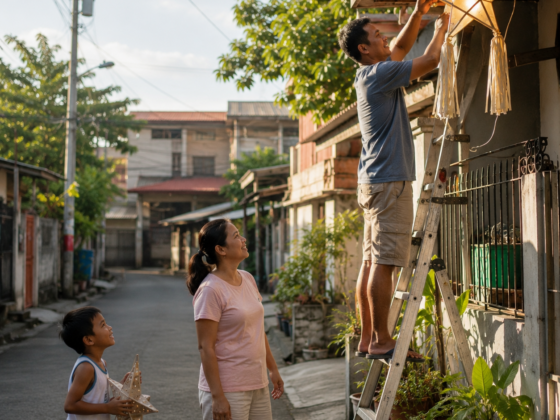
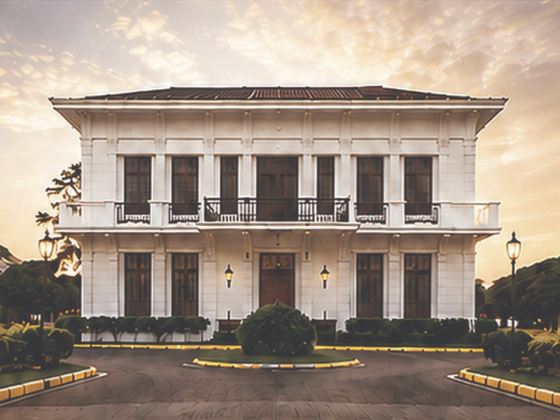
Drive through any provincial town in the Philippines and you will eventually find it: the house that doesn’t quite fit. Bigger than its neighbors. More finished, or mid-construction but clearly intended to be grander once the next remittance cycle comes through. A gate slightly too substantial for the street it stands on. Windows that face a mountain or a rice field or simply the horizon. This is a home built on foreign earnings, and it is one of the most legible symbols of what diaspora investment actually looks like at the household level.
The Philippines’ real estate sector has been shaped, in ways still being fully mapped by industry analysts, by the purchasing psychology of Filipinos abroad. Property developers recognized this early. Ayala Land, SM Prime, Vista Land, and a wide range of regional developers have built product lines and entire sales operations oriented around the diaspora market, with offices and roadshows in the Gulf, in North America, in Europe and Australia. The pitch is never simply about location or return on investment. It is about home as a destination, about having a place that is yours and waiting, about the idea of return made concrete.
The Subdivision and Housing Developers Association has noted that OFW-driven demand has been a consistent stabilizing force in the residential property market, particularly in provincial areas where local purchasing power alone could not sustain the construction activity the country has seen. In Calabarzon, Central Luzon, and across the Visayas, residential developments exist at a scale and quality that the local wage economy does not fully explain. The explanation is found in the money sent from elsewhere, guided by an intention formed years before the foundation was poured.
For many Filipino families abroad, property is not a financial instrument. It is the physical form of a promise: that the sacrifice meant something, that there is something solid to come back to, that the distance was always temporary even when it turned out not to be.
THE DIPLOMA WAS ALWAYS THE POINT
Survey after survey of Filipinos living and working abroad, including longitudinal research from the Philippine Overseas Employment Administration and academic work from the University of the Philippines School of Labor and Industrial Relations, returns to the same finding: children’s education is the primary stated motivation for sustaining life abroad. Not property. Not retirement savings. The diploma.
This is not a small cultural preference. It is the engine of intergenerational mobility for millions of Filipino families, and it has quietly built a private education sector that operates well above what the country’s average income level would typically support. The proliferation of private schools, colleges, and universities across the Philippines, many of them in cities and towns that would not otherwise sustain them, is inseparable from the fact that diaspora parents are paying tuition in foreign currency, year after year, for children they often see only during the holidays.
The Commission on Higher Education has tracked a consistent pattern: provinces with high diaspora populations show stronger tertiary enrollment rates, even when local economic conditions would otherwise predict the opposite. The money flows through the family and into the institution, and the institution produces graduates who carry the ambition their parents invested in them.
The ADB and World Bank research on brain circulation in developing economies has moved away from the earlier, grimmer framing of brain drain to describe something more dynamic: a pattern in which education, exposure, and professional experience move outward through migration and return, transformed, through the people who absorbed them. The Filipino who studied on a scholarship in Australia, or who worked in a Singapore firm for a decade before coming home, does not return empty-handed. They return with standards, with networks, with a bilingual and bicultural fluency that is increasingly, in a globalized economy, the most valuable thing a person can carry.
CAPITAL WITH MEMORY
What is changing fastest in the diaspora story, and what this issue of Balikbayan Magazine is most interested in documenting, is the nature and direction of Filipino investment abroad shifting from consumption back toward origin.
The Commission on Filipinos Overseas has documented growing patterns of what researchers are beginning to call diaspora direct investment: capital from Filipinos abroad going not into property or household consumption but into businesses, agricultural ventures, social enterprises, and technology startups in the Philippines. The profile of this investor is distinct from the traditional migration narrative. They are often younger, often holding professional or academic credentials from abroad, and often motivated by something that is not purely financial return.
Research from the Migration Policy Institute on diaspora investment globally identifies a consistent psychological driver in this category: the desire to participate in a place that shaped you, or that shaped the people who shaped you. For Filipino-Americans, Filipino-Australians, and the children of migrants who grew up watching parents sacrifice for a country they simultaneously loved and left, investment can function as a form of inherited loyalty made actionable. It is the financial expression of a debt that was never financial to begin with.
The food and beverage industry has absorbed much of this energy, partly because food is the most immediate and personal expression of cultural identity, and partly because it is an accessible entry point for investors who are not yet ready for larger capital commitments. But the pattern is extending into agriculture, creative industries, digital infrastructure, and professional services. Filipino designers abroad are sourcing from local weavers and positioning Philippine textiles in international markets. Filipino academics are consulting for domestic institutions. Filipino technologists are building products for the Philippine market from offices in San Francisco and Berlin.
The ADB has used the term brain circulation to describe this dynamic, and it is the more accurate frame. The knowledge, capital, and cultural confidence that left the Philippines through its people is beginning to complete a circuit, and what returns is more compounded than what departed.
WHAT THEY BRING BACK
The most significant shift in the diaspora story right now is not economic. It is directional.
For the first time in the modern history of Philippine migration, the flow is beginning, in modest but meaningful ways, to turn. The Commission on Filipinos Overseas has noted increasing repatriation activity among Filipinos abroad, particularly among those in professional and skilled categories who see genuine opportunity in the Philippines’ growing digital economy, its expanding consumer class, and its still-competitive cost of doing business relative to the cities many of them left.
They return with what they absorbed. With expectations around systems and process shaped by having worked in places where systems worked. With professional networks that stretch across industries and borders. With a dual fluency, cultural and linguistic and professional, that is increasingly difficult to replicate through any domestic education or training alone. And with something less tangible but equally real: the desire to build something in the place that made them, or that made the people who made them.
The philosopher and cultural theorist E. San Juan Jr., whose decades of writing on the Filipino diaspora remains among the most rigorous engagement with these questions in the academic literature, has argued that the experience of Filipino migration cannot be separated from structural conditions: the decisions, made over generations, that shaped who left and why. That context does not diminish what individual Filipinos built from abroad. It makes what they built more remarkable, and the question of what they might build upon returning more urgent.
The Philippines has spent decades learning how to receive what its diaspora sends. The more interesting challenge, and the one this generation of returning Filipinos is actively posing, is whether the country is ready for what they are bringing back.
There are Filipinos thriving on every continent right now. Teaching, designing, cooking, coding, healing, building, raising children who will grow up with two languages and three loyalties and no clean answer to the question of where they are from.
They are not a diaspora in the elegiac sense, scattered and longing. They are a network, alive and self-reinforcing, connected by something that has proven more durable than distance. The Philippines, at its best, knows this about itself. At its best, it claims all of them, not just the ones who came back, but the ones still out there, still building, still Filipino on their own terms.
That is the story this issue is trying to tell. Not the story of departure. The story of everything that came after.






1 comment
This article offers a moving shift in the narrative surrounding the Filipino diaspora, framing migration not merely through the lens of economic sacrifice or “brain drain,” but through dynamic “brain circulation” and evolving identity. It beautifully captures how home for overseas Filipinos transcends geographical boundaries—manifesting in record-setting remittances, provincial dream homes, intergenerational mobility via education, and the return flow of capital, expertise, and cultural pride. Ultimately, it redefines the diaspora as an interconnected, living network actively shaping the future of the Philippines from wherever they are in the world.
Comments are closed.