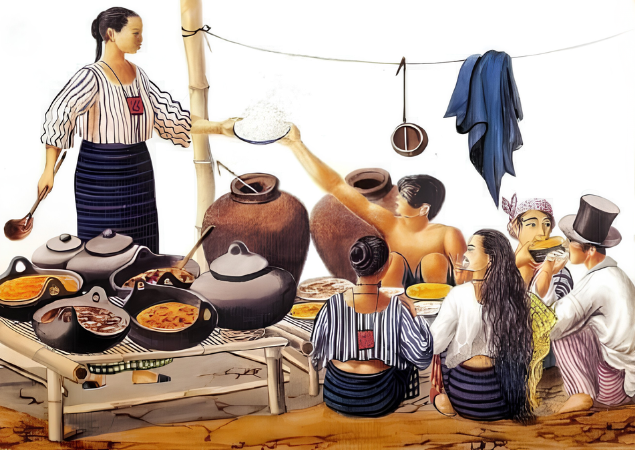
“Tendera en la carenderia,” a watercolor painting by Jose Honorato Lozano, Biblioteca Nacional de España, 1847. Photo courtesy of the National Historical Commission of the Philippines
Carinderias—those unassuming roadside eateries with steaming kalderos, tin pitchers, bottles of sawsawan (Filipino dipping sauces) and the unmistakable aroma of home—are among the most democratic spaces in Philippine food culture. They feed workers, students, travelers, and entire communities, offering sustenance that is both affordable and deeply rooted in history. Their story, however, is far older and more global than many realize.
FROM CROSSROADS TO COMMUNITY TABLE
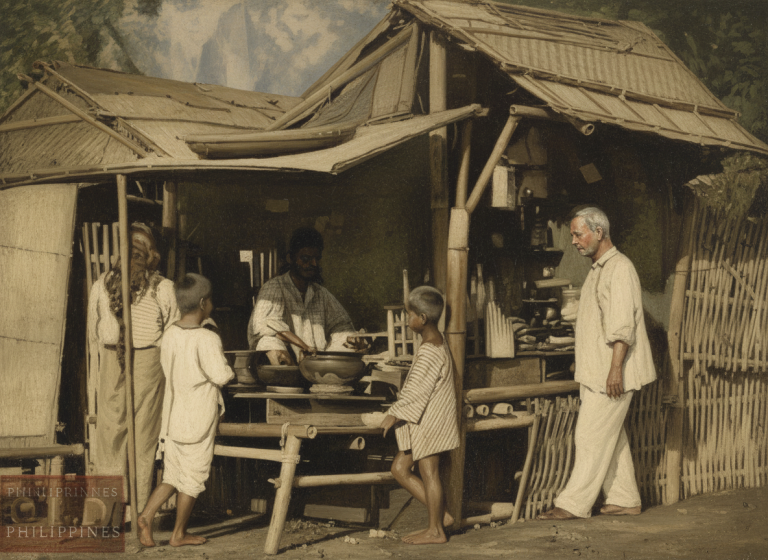
The earliest carinderias emerged in the early 1800s as native food shops serving travelers along busy crossroads. Before 1764, there was no Filipino term for a commercial cooked-food establishment, but by the 19th century, these eateries had become essential stops for locals and wayfarers alike.
Their evolution into the “turo-turo” format—where diners point to their chosen dishes—reflected a uniquely Filipino adaptation: fast, communal, and rooted in everyday life.
THE SEPOY LEGACY: CAINTA, TAYTAY, AND THE TASTE OF CURRY
A pivotal chapter in the carinderia story begins during the British occupation of Manila (1762–1764). Indian infantry soldiers known as Sepoys, many of whom deserted the British fleet, settled in Cainta and Taytay after marrying Filipina women. These towns lay along the Marian pilgrimage route to Antipolo during the month of May, making them natural hubs for food stalls catering to travelers.
These Sepoys introduced curry-based dishes, influencing both the menu and the very name of the carinderia. Spanish scholar Wenceslao Retana traced the word carinderia to kari—Tagalog for curry—which also forms the root of kare-kare.
Thus, what we now consider a quintessentially Filipino eatery has origins intertwined with South Asian flavors and the multicultural currents of colonial history
ANTIPOLO PILGRIMAGE: THE FIRST FOOD TOURISM CORRIDOR
The May pilgrimage to Antipolo—one of the oldest Marian devotions in the country—helped transform carinderias into thriving culinary stops. Pilgrims traveling by banca, hammock, horse, or later by train (after the railway’s inauguration in 1892) relied on these eateries for nourishment. Cainta and Taytay, positioned at key transfer points, saw a boom in bamboo stalls offering mixed menus that included curry and local stews. This early form of food tourism helped cement the carinderia as a fixture of Filipino travel culture.
DOREEN FERNANDEZ AND THE CARINDERIA IN THE NATIONAL IMAGINATION
No discussion of Filipino foodways is complete without Doreen Gamboa Fernandez, whose writings in the late 20th century documented the everyday cuisine of the archipelago. Her body of work—particularly Tikim and her columns in the Philippine Daily Inquirer—played a crucial role in elevating humble dishes and local eateries into subjects worthy of scholarship and national pride.
Her approach validated the carinderia as a cultural archive: a place where regional flavors, migrant histories, and community memory converge in a single plate of adobo, laing, or kare-kare. Culinary afficionados choose winners of the Doreen Fernandez Food Writing Award every year. The first food writing award of its kind in the Philippines, popular food writers participate as organizers and judges.
FROM STREETSIDE TO MICHELIN
In recent years, the global culinary world has begun to recognize the value of Filipino everyday cooking. Michelin’s Bib Gourmand category encompasses carinderias and other eateries that operate in the spirit of the carinderia—affordable, home-style, and deeply local—have been acknowledged in contemporary food guides.
Michelin Bib Gourmand awardees in the Philippines, though not traditional carinderias, reflect the same ethos of accessibility and flavor. One example is Morning Sun Eatery in Quezon City, a modest roadside eatery which serves authentic Ilocano comfort food, turo-turo style, offering home-style classics such as kilawin, sweet pork skewers, pinakbet and the standout laing: taro leaves simmered in coconut milk.
Local food guides and media features, including popular vlogs on YouTube that increasingly spotlight turo-turo style eateries, such as Aling Sosing’s featured in our header, for their authenticity and cultural significance.
Carinderias remain as economic lifelines for small entrepreneurs, culinary classrooms where generations learn to cook, cultural touchstones that preserve regional identity, spaces of belonging for workers, students, and travelers. Their menus—shaped by indigenous traditions, colonial encounters, migration, and devotion—tell the story of the Filipino people.
NOTABLE BICOL CARINDERIAS
Carinderias in Bicol are more than eateries—they are community anchors, culinary archives, and everyday sanctuaries where the region’s flavors, histories, and identities converge. While many remain humble and undocumented, several have become beloved institutions known for consistency, generosity, and the unmistakable Bicolano balance of foundational ingredients: gata (coconut milk) for creaminess and siling labuyo (local chili peppers) for fiery heat.
The carinderia is more than a food stall. It is a living chronicle of movement and memory—from Sepoys in Cainta to pilgrims in Antipolo, from Doreen Fernandez’s essays to today’s Michelin-acknowledged dining scene.
Where flavors are bold and histories are layered, the carinderia continues to thrive as a place where stories simmer alongside sinigang, and where every meal is a reminder of the journeys—geographical, historical, and personal—that shape the Filipino table.