For many countries, Christmas is a holiday. In the Philippines, it is a season that tells the story of who we are. It lives in centuries-old traditions, airport reunions, dawn Masses, family tables, and the quiet hope that no matter how far life takes us, there is always a way home.
By Billy De La Cruz
Every September, the Philippines begins doing something that much of the world finds slightly bewildering.
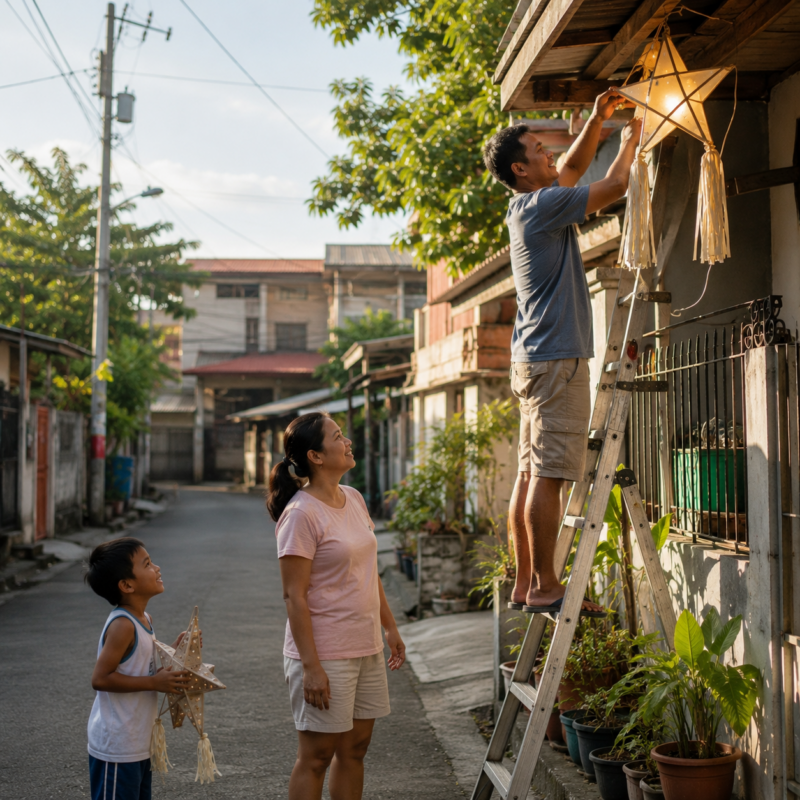
While most countries are still enjoying the final weeks of summer or welcoming the first signs of autumn, Christmas quietly begins to arrive across the archipelago. Radio stations slip familiar holiday songs into their playlists. Shopping malls unpack decorations that have barely gathered dust since January. Star-shaped lanterns appear outside homes and businesses. Families separated by oceans begin discussing travel plans, airfare prices, and long-awaited reunions months before December has even entered the conversation.
To outsiders, it is one of the country’s most charming peculiarities. Every year, travel articles and international news outlets repeat the same familiar headline: The Philippines celebrates the world’s longest Christmas season.
The statement is true. But it is also incomplete.
To describe the Filipino Christmas simply by the number of months it occupies is like describing the ocean by its shoreline. It captures the outline but misses its depth. The early decorations and holiday music are merely the most visible expressions of something far more profound, a tradition shaped by centuries of history, strengthened by faith, sustained by migration, and defined by an enduring belief that life is best celebrated together.
Christmas did not become extraordinary in the Philippines because it starts in September.
It became extraordinary because, over generations, Filipinos transformed it into something that extends well beyond the holiday itself. It became a season through which families reconnect, communities renew old traditions, and millions of Filipinos scattered across the world rediscover their ties to home.
To understand why Christmas lasts so long in the Philippines, one must first understand what Christmas has come to represent.
It is not simply a celebration.
It is a reflection of the Filipino identity itself.
MORE THAN FOUR HUNDRED YEARS IN THE MAKING
Christmas arrived in the Philippines with Spanish missionaries during the sixteenth century, bringing with it religious observances that were already deeply rooted in Catholic Europe. Midnight Masses, Nativity scenes, Christmas hymns, and the celebration of Christ’s birth gradually became part of life in the islands, particularly as Christianity spread throughout the archipelago.
History, however, rarely leaves traditions untouched.
Over the next four centuries, Filipinos did far more than preserve these customs. They reshaped them, blending religious devotion with local culture, indigenous craftsmanship, family-centered values, and an unmistakable sense of community. The result was not a copy of a European Christmas but something entirely distinct, recognizable anywhere in the world as unmistakably Filipino.
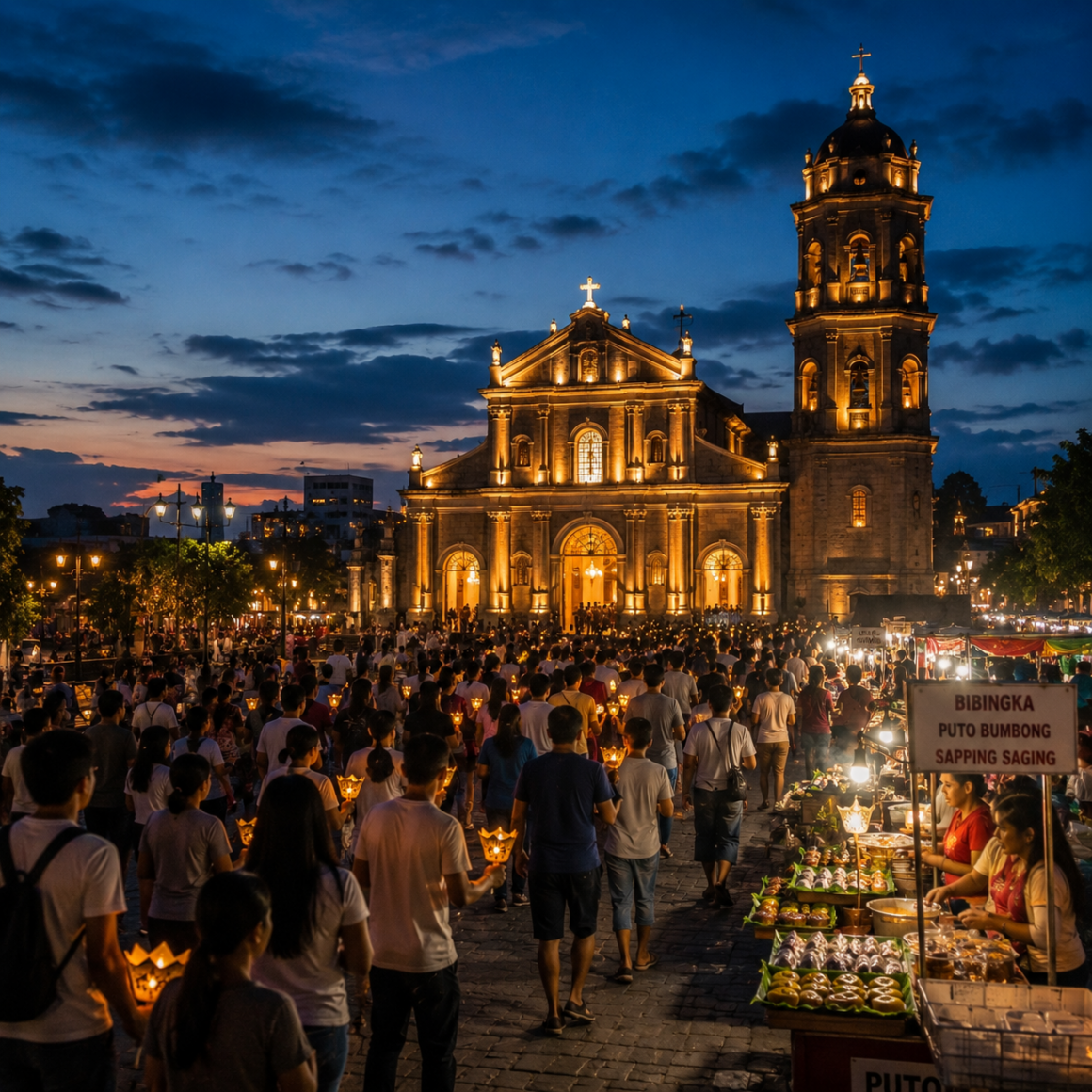
Simbang Gabi offers perhaps the clearest example.
Originally introduced so farmers could attend Mass before beginning work in the fields, the nine-day novena became one of the country’s most cherished traditions. Long before sunrise, churches fill with worshippers who gather not merely out of obligation but out of habit, devotion, and shared memory. Outside, vendors prepare bibingka and puto bumbong while conversations continue long after the final blessing has been given. The morning becomes as important as the liturgy itself. It is an experience that blends faith, food, friendship, and familiarity into a ritual that has endured for generations.
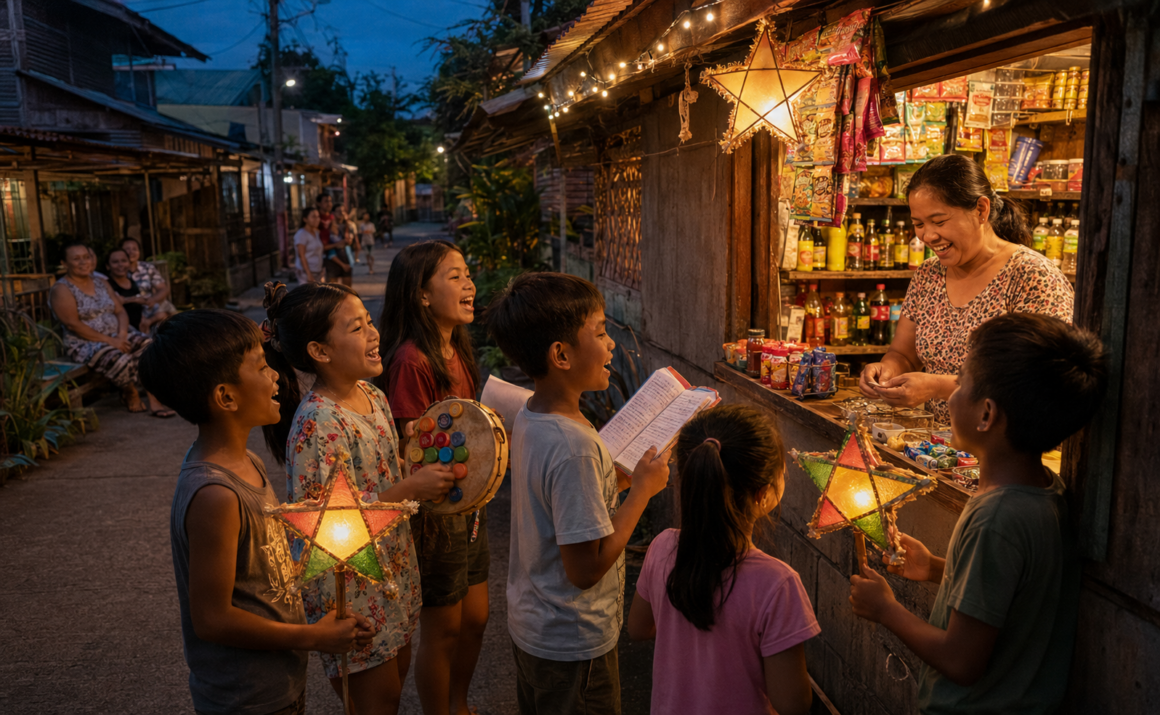
The same transformation can be seen in the humble parol. Though inspired by the Star of Bethlehem, the lantern has become something uniquely Filipino. Crafted from bamboo, capiz shells, paper, or recycled materials, it hangs outside homes not only as a symbol of Christmas but also as a quiet declaration of hope. Whether elaborate or handmade, every parol tells the same story: light remains possible even after darkness.
Even Noche Buena reflects this distinctly Filipino interpretation of Christmas. Across the country, families gather shortly before midnight around tables filled with dishes that vary from region to region and household to household. The meal itself is important, but its true purpose lies elsewhere. It creates a reason for everyone to come home, to linger at the table, to exchange stories, and to enjoy one another’s company long after the plates have been cleared.
These traditions survived not because they were carefully preserved in museums or history books.
They survived because every generation found new reasons to keep them alive.
A NATION THAT KNOWS THE MEANING OF DISTANCE
Few countries understand separation quite like the Philippines.
For decades, millions of Filipinos have built lives beyond its shores. They serve as nurses in London and New York, engineers in the Middle East, caregivers in Italy, teachers in Canada, seafarers crossing every ocean, and entrepreneurs in cities spread across every continent. Their work has strengthened economies abroad while supporting families back home through sacrifice, perseverance, and love.
The Filipino diaspora has become one of the largest in the world, but behind every statistic lies a quieter story. It is the story of birthdays celebrated through video calls, graduations watched from thousands of miles away, children growing older between visits, and parents who count the months until another reunion becomes possible.
Migration has shaped modern Filipino life in countless ways, but perhaps nowhere is its influence more deeply felt than at Christmas.
Throughout the year, distance is accepted as a necessary reality. Families learn to adjust. Daily routines continue. Life moves forward.
December changes everything.
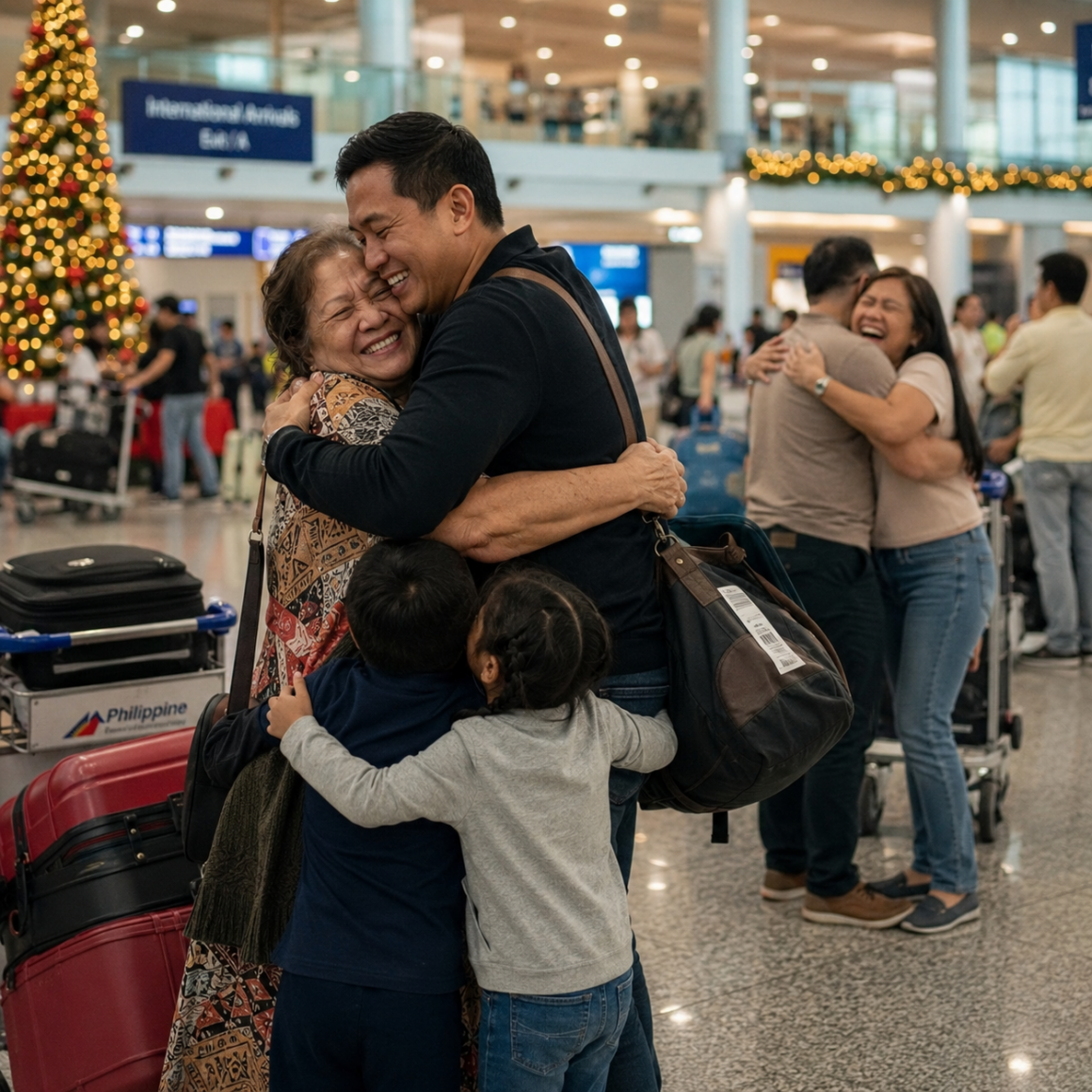
Airports become places of extraordinary emotion. Arrival halls fill with embraces that seem to erase months or even years of separation in an instant. Children run toward parents they have not held in far too long. Grandparents quietly wipe away tears before anyone notices. Entire families gather to welcome someone home, transforming an ordinary arrival into a celebration that rivals Christmas Day itself.
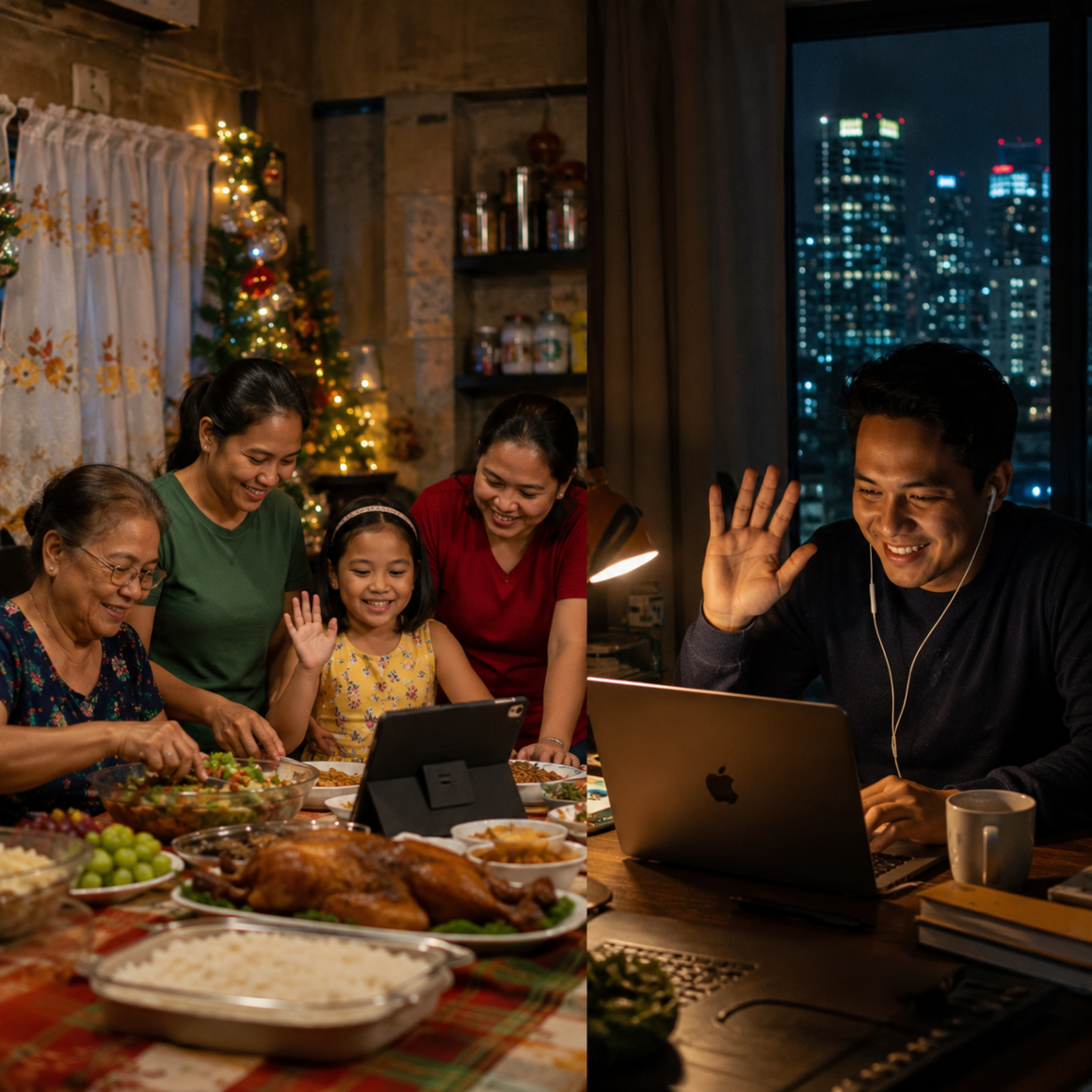
For those unable to return, the rituals simply evolve. Dinner is scheduled around different time zones. Phones and laptops occupy places at the table. Gifts are opened together despite oceans that separate living rooms. Technology may shorten the distance, but it is tradition that keeps families connected.
This is why Christmas occupies such a singular place in the Filipino imagination.
It is not only the celebration of Christ’s birth.
It is the celebration of reunion.
JOY AS AN ACT OF RESILIENCE
There is a word often used to describe Filipinos: resilient.
It appears after typhoons flatten entire communities. It resurfaces after earthquakes, economic crises, political upheaval, and the countless personal hardships that rarely make headlines. It has become a defining characteristic, repeated so often that it sometimes risks becoming little more than a convenient label.
Yet resilience, by itself, simply means the ability to recover.
It does not fully explain why Filipinos continue to celebrate with such enthusiasm even when circumstances suggest they have every reason not to.
Perhaps the answer lies in understanding that Christmas in the Philippines has never been a reward for easy lives. It has often been the very thing that helps people endure difficult ones.
Throughout history, generations of Filipinos have experienced periods of uncertainty. Wars interrupted ordinary life. Natural disasters reshaped communities overnight. Economic realities compelled millions to seek opportunities abroad, often at the cost of years spent away from those they loved most. Even today, countless families spend much of the year making sacrifices that are invisible to everyone except those closest to them.
Christmas does not erase those realities.
Instead, it places them in perspective.
For a brief season, the emphasis shifts away from what has been lost and toward what remains. Families gather despite financial limitations. Communities organize celebrations regardless of how modest they may be. Churches fill before dawn, not because life has become easier, but because hope remains worth celebrating.
This is not optimism born of comfort.
It is optimism practiced in spite of discomfort.
That distinction matters.
To many Filipinos, celebrating Christmas is not an act of forgetting hardship. It is a quiet refusal to allow hardship to become the final chapter of the year.
Perhaps that is why the season feels so deeply woven into the national character. It reminds people that joy does not always arrive after adversity has passed. Sometimes it exists alongside it.
A TRADITION THAT CROSSED OCEANS
Today, Filipino Christmas is no longer confined to the islands.
It lives in cathedrals in Rome, parish halls in Toronto, community centers in Sydney, apartment buildings in Dubai, and neighborhoods across California where parols hang beside wreaths and snow-covered sidewalks lead to Simbang Gabi services before sunrise.
What began as a local celebration has become a global one because Filipinos have carried it wherever life has taken them.
This has had an unexpected consequence. Christmas has become one of the strongest cultural threads connecting generations of Filipinos born far from the Philippines.
For children and grandchildren raised overseas, the holiday often serves as an introduction to heritage. They learn recipes that have survived generations, hear stories about hometowns they have never visited, and discover customs that are unfamiliar to their classmates but instantly recognizable within their own families.
Culture, they learn, is not preserved only in museums or history books.
It is preserved around dining tables.
In kitchens.
In churches.
In conversations that begin with, “This is how your grandmother used to make it.”
For many families, Christmas has become the annual reminder that identity is not measured by geography alone.
A passport may identify where someone lives.
Tradition often reveals where they belong.
THE SEASON THAT REMINDS US WHO WE ARE
It is tempting to explain the Filipino Christmas through statistics.
The world’s longest celebration.
Millions of overseas Filipinos returning home each year.
Thousands of lantern festivals, community gatherings, and religious observances stretching from September into January.
Those numbers are impressive.
They are also insufficient.
The true significance of Christmas in the Philippines cannot be measured by the length of the season, the number of decorations, or the size of family gatherings.
Its significance lies in what the celebration continues to accomplish year after year.
It reunites families divided by oceans.
It keeps centuries-old traditions alive without making them feel old.
It gives younger generations a living connection to their heritage.
It reminds communities that generosity is measured not by abundance but by the willingness to share.
Most importantly, it creates a moment when an entire nation, despite its diversity of languages, regions, and experiences, pauses to celebrate many of the same values: faith, family, gratitude, hospitality, and hope.
That may be the greatest achievement of the Filipino Christmas.
It has become one of the few traditions capable of bringing together people whose lives otherwise look remarkably different.
MORE THAN THE WORLD’S LONGEST CHRISTMAS
Every September, someone will once again ask why Filipinos celebrate Christmas so early.
It is an understandable question.
But perhaps it has never been the right one.
The more revealing question is why Christmas has endured with such extraordinary meaning for generations of Filipinos, whether they live in Manila or Madrid, Cebu or Chicago, Davao or Dubai.
The answer cannot be found in calendars.
It is found in airport arrival halls where families wait behind glass doors, counting the seconds until they can embrace someone they have missed for months or years. It is found in kitchens where recipes are prepared exactly as parents and grandparents once taught them. It is found in church pews filled before dawn, in parols glowing softly outside homes, and in voices singing songs that instantly dissolve the distance between memory and the present.
The Philippines may indeed celebrate the world’s longest Christmas.
But perhaps that distinction is simply the visible expression of something much older and much deeper.
For Filipinos, Christmas has never been confined to a single day.
It has become a season of return, a celebration of resilience, and a living reminder that home is not defined solely by the place where we live, but by the people, traditions, and memories we carry with us wherever life may lead.
That is why Christmas begins long before December.
And why, for so many Filipinos, it never truly ends.