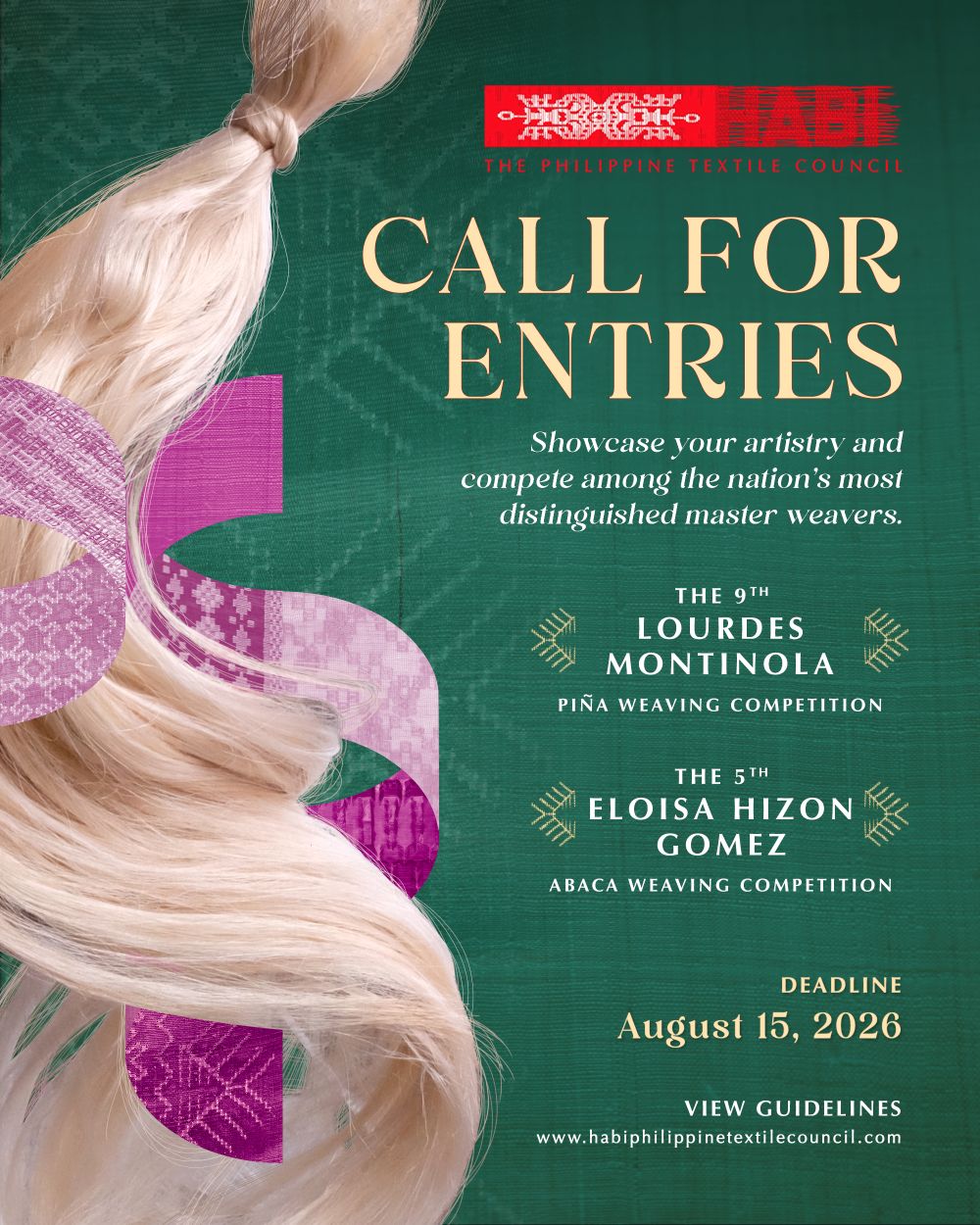
Submission deadline: August 15, 2026. Awarding ceremonies to be held during the 16th Likhang Habi Market Fair at Space One Ayala, Makati City
(Mandaluyong City, May 12, 2026)….. HABI: The Philippine Textile Council opens the call for entries to two of the country’s most prestigious textile competitions: the
9th Lourdes Montinola Piña Weaving Competition and the 5th Eloisa Hizon Gomez Abaca Weaving Competition, continuing a long-standing commitment to safeguard, celebrate, and advance the artistry of Philippine handwoven textiles.
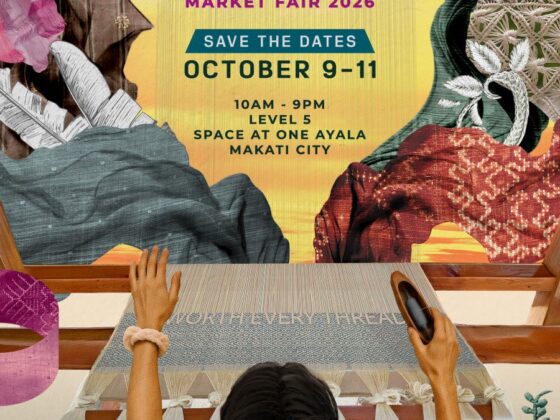
Held as the centerpiece events of the 16th Likhang Habi Market Fair from October 9 to 11, 2026 at Space at One Ayala, Makati City, the competitions honor the mastery, innovation, and cultural legacy carried by generations of Filipino weavers.
Together, the competitions have become important platforms for recognizing excellence in piña and abaca weaving — traditions deeply woven into the nation’s history and identity, and sustained today by artisan communities across the archipelago.
“The most encouraging aspect of these weaving competitions is the response of the weavers themselves — how they rise imaginatively to the challenge,” says Adelaida Lim, president emeritus of HABI. “Each entry piece is pure delight. I always look forward to the surprises.”
Honoring Masters, Preserving Traditions
Named after educator, cultural advocate, and author of the landmark book Piña, the Lourdes Montinola Piña Weaving Competition celebrates the extraordinary craftsmanship and evolving artistry of pineapple fiber weaving.
Entries are accepted in the following categories:
- Liniwan — plain weave demonstrating fineness, uniformity, and technical excellence
- Pure Piña — highlighting the beauty and creative potential of pure piña fiber
- Natural Fiber Blends — encouraging innovation through combinations of piña with silk (seda), jusi, cotton, or abaca
All entries must measure at least two meters in length.
The Eloisa Hizon Gomez Abaca Weaving Competition was established through the initiative of Dom Martin Gomez, OSB — formerly haute couture designer Gang Gomez — and his siblings, in honor of their mother’s lifelong dedication to Philippine textiles and traditional attire.
The competition welcomes entries in these categories:
- Resist Dye on Abaca — featuring ikat and related resist-dye techniques
- Abaca Craft — showcasing craftsmanship through macramé, crochet, tatting, bobbin lace, and related techniques
- Abaca Nipis — recognizing fineness, uniformity, and weaving skill in sheer abaca cloth
All entries must be made from 100% abaca fiber and measure at least two meters in length.

Awards and Recognition
Winners in each category will receive cash prizes and special citations. Separately, the competition also confers two special distinctions: the Nadres Young Weaver Award and the Filip + Inna Innovation Award, each recognizing excellence in distinct aspects of weaving practice and innovation.
Entries will be evaluated by an esteemed panel composed of experts from the fields of fashion, textile arts, heritage conservation, and academe, including heirs of Lourdes Montinola and Eloisa Hizon Gomez.
Last year’s competitions drew outstanding entries from weaving communities nationwide. Winners of the 8th Lourdes Montinola Piña Weaving Competition included Rosemarie Loveras (Liniwan), Melanie Palmon (Pure Piña), and Raquel Eliserio (Natural Fiber Blends).
At the 4th Eloisa Hizon Gomez Abaca Weaving Competition, honors went to Ulaniban Laginan (Resist Dye on Abaca), Myra Iledan and Arlene Yamog (Abaca Craft), and Arnie I. Almero (Abaca Nipis).
All accepted entries will be exhibited at the 16th Likhang Habi Market Fair, offering the public an opportunity to experience the richness and continuing evolution of Philippine textile traditions.
The awarding ceremony for the Piña competition will be held on October 10, while the Abaca competition awarding will take place on October 11.
“What is exciting are the different and higher quality designs that come from past tradition enhanced by modern ideas of decoration,” says Maribel Ongpin, HABI Chairman Emeritus.
“We hope that many traditional weavers will join and that many younger weavers will be inspired to join, too. The combination of young and old, tradition and innovation, is always exciting,” she adds.
The competition is open to all Filipinos residing in the Philippines. Interested parties can send their creations to the Habi office at 962 May Street, Mandaluyong City before the deadline on August 15, 2026.
Full competition details and entry forms are available on the HABI website at www.habiphilippinetextilecouncil.com .
Additional inquiries may be directed through HABI’s social media accounts
Facebook – https://www.facebook.com/HABICouncil OR
Instagram https://www.instagram.com/habicouncil
About HABI: The Philippine Textile Council
Founded in 2009, HABI: The Philippine Textile Council is a nonprofit organization dedicated to preserving, promoting, and innovating the Philippines’ rich textile traditions. Through fairs, exhibitions, research, and advocacy, HABI works closely with weaving communities, designers, and educators to uplift the handwoven textile industry and ensure these cultural treasures continue to thrive for generations to come.
Key Aspects of HABI:
- Mission: To revive traditional textile skills, promote the use of local fibers, and integrate indigenous fabrics into modern, everyday life.
- Key Activities:
- Likhang HABI Market Fair: An annual event (often held in October) featuring the best weavers and artisans from across the Philippines.
- Advocacy & Education: Conducts training on weaving and natural dyes, such as Abaca weaving training and the resurgence of pure cotton usage.
- Research & Documentation: Works with communities to document traditional techniques and designs, producing documentaries like “Threaded Traditions”.
- Significance: HABI was formed to fill the void of a dedicated textile society in the Philippines, addressing the decline of the handloom industry and bringing awareness to unique, locally woven textiles.
- Recent Projects: Ongoing initiatives include providing skill-building workshops in regions like Catanduanes and promoting the certification of local piña weaving.
HABI acts as a bridge between tradition and contemporary design, ensuring that the rich heritage of Philippine weaving is maintained and honored.