
By Lance Gregory
Memory has many triggers, but few are as powerful as music. A photograph reminds us of what happened. A familiar song reminds us how it felt. That may explain why Christmas in the Philippines is remembered as much through melodies as through traditions. Certain songs have become annual rituals, returning year after year to tell Filipinos that the most anticipated season has begun.
JOSE MARI CHAN: THE VOICE OF FILIPINO CHRISTMAS
No Filipino artist is more closely associated with Christmas than Jose Mari Chan. His 1990 album Christmas in Our Hearts has become so deeply woven into the season that its return each September has become an internet joke and a cultural event at the same time. Yet the reason it endures goes beyond nostalgia. The songs speak about family, faith, generosity, and coming home, themes that resonate deeply in a country where Christmas is as much about reunions as celebrations. For millions of Filipinos, Christmas doesn’t officially begin until Jose Mari Chan starts singing.
MARIAH CAREY AND A GLOBAL TRADITION
If Jose Mari Chan represents the Filipino heart of Christmas, Mariah Carey represents its global soundtrack. All I Want for Christmas Is You has become a December ritual in malls, cafés, office parties, and karaoke sessions across the Philippines. Released in 1994, the song has found an audience across generations, proving that holiday traditions continue to evolve. It now sits comfortably beside Filipino classics, creating a uniquely local playlist where international pop and homegrown favorites coexist.
THE CHRISTMAS STATION IDS WE NEVER FORGET
Few countries celebrate Christmas through television quite like the Philippines. Every year, major television networks release elaborate Christmas Station IDs that go far beyond promoting a brand. They become reflections of the nation’s hopes, struggles, and triumphs. Their original songs often dominate radio stations and social media for weeks, while memorable lines become part of everyday conversations. Ask Filipinos about a particular Christmas, and many will remember it by the Station ID that defined that year.
THE SONGS WE SANG DOOR TO DOOR
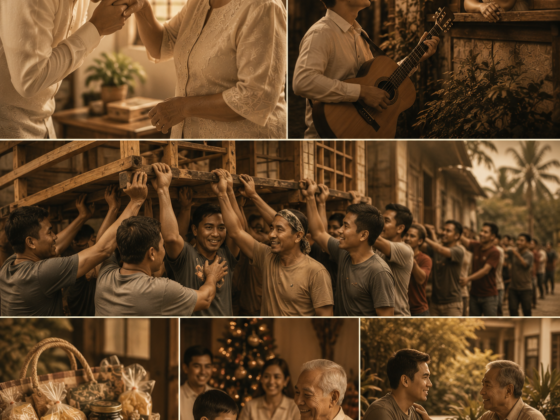
Before streaming playlists and Bluetooth speakers became part of the season, Christmas music often came from the neighborhood itself. Groups of children carrying handmade tambourines fashioned from bottle caps, improvised drums, or simply their own voices would go from house to house singing familiar carols in exchange for coins, candies, or warm smiles. It was never about perfect harmony. The charm was in the enthusiasm, the laughter, and the excitement of seeing another gate open.
Years from now, few people will remember exactly what gifts they received or what decorations adorned the house. But they will remember the songs. They will remember where they first heard Jose Mari Chan that year, the television anthem everyone sang, the laughter that interrupted Christmas carolers at the gate, or the tune that played while the family gathered around the Noche Buena table. That is the quiet power of music. It doesn’t simply accompany Christmas. In the Philippines, it preserves it.